Phonological Decoding and Reading Comprehension in deaf and hard of hearing children
Dr Elizabeth Mathews discusses phonological decoding and reading comprehension in relation to literacy outcomes for deaf and hard of hearing children.
Description
Many deaf and hard of hearing (DHH) children receive intensive intervention to help them acquire spoken language. This can facilitate the development of phonological skills which may later contribute to successful phonological decoding as children learn to read. However, underlying language delay can remain a concern for DHH children and while children may decode successfully, they may not comprehend what they read.
In this presentation, Dr Elizabeth Mathews examines this topic by highlighting a study carried out in Ireland that sought to examine if there was a gap between phonological decoding and reading comprehension among a sample of DHH children attending mainstream schools in Ireland. Forty DHH children aged between seven and thirteen years of age were tested using two separate reading assessments selected to measure the skills of phonological decoding and reading comprehension.
While most DHH children were, on average, reading within the normal range compared with their hearing peers, the research highlighted a distinct gap between decoding and comprehension skills among the sample. Furthermore, while decoding and comprehension skills correlated strongly and significantly for younger children in this sample, this relationship disappeared with older children.
VDEI recommend the use of Google Chrome, Firefox, Edge or Safari (Macintosh users only) as the preferred web browsers to seamlessly register and access this learning.
Please note – Victorian Department of Education staff can access this professional learning offering free of charge. Enter your @education.vic.gov.au email address during the registration process to ensure the registration fee is waivered.
Learning Outcomes
Participants will be able to:
- explain the Simple View of Reading (SVR)
- characterise the difficulties experienced by DHH children in reading
- describe the key findings of an Irish research study on literacy, and consider:
- the implications for DHH children who use sign language
- the implications for their own teaching contexts.
Presenters
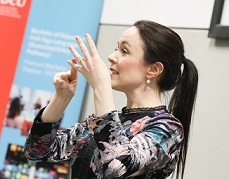 Dr Elizabeth Mathews is an Assistant Professor with the School of Inclusive and Special Education at Dublin City University (DCU) St. Patrick’s Campus, where she specialises in the area of deaf education. She completed her MA in Deaf Education at Gallaudet University, Washington DC as a recipient of the Dr. Mary L. Thornton Scholarship and a Fulbright Student award.
Dr Mathews completed her PhD with Maynooth University (2011) funded by the Department of Children and Youth Affairs. Previously, she was the coordinator of the Deaf Education Centre in Cabra, Dublin and currently sits on the Board of Management of Holy Family School for the Deaf in Cabra.
Dr Mathews is the author of Language, Power, and Resistance: Mainstreaming Deaf Education and has recently led an innovative initiative to provide, for the first time, access to primary teaching for Deaf ISL users in the Republic of Ireland.
Course Flyer
Accessibility
This On-Demand presentation is delivered in spoken English with captioning
Completion
Participants who successfully complete this On-Demand Presentation will receive a certificate noting 2 hours of professional learning.